Explosion Network may receive a commission when you purchase something via a link on our site
Game Design: Javier Untoria, Sara Pantoja, Pol Blanes
Programming: Andre Taulien
Art Director: Daniel Candil
Developer: Alkimia Interactive
Publisher: Alkimia Interactive, THQ Nordic
Platforms: PlayStation 5, PC (reviewed on – AMD 9800X3D, Radeon 9070XT, 64GB DDR5 RAM, Steam Deck), Xbox Series X|S
Release Date: 06/06/2026
The Gothic 1 Remake is a complete rebuild of a classic role-playing game that hails from an era marked by brutality. This RPG only offers minimalistic guidance and no handholding; instead, it presents a challenging mix of exploration, learning, and figuring things out on your own.
I am new to this type of RPG, as most recent releases in this genre guide players into the world with a backstory and some direction. However, Gothic is completely different; from the very beginning, you are dropped into the world with minimal context and set on your own path. I found myself navigating this dark and dangerous environment with little guidance. The opening video provides a vague explanation of what is expected of me, as my character is beaten and cast into a colony. I am eventually rescued by a man named Diego, who offers to help me reach the Old Camp. Initially, I declined his offer, believing that as an adventurer, I didn’t need assistance and could fight my way to the camp on my own.
As I opened my menu and checked my inventory, I quickly realised that there was no map, compass, or waypoint marker available. No matter, I felt determined and decided to follow the only path leading out of the quarry I was in. How hard could it be? However, it turned out to be more challenging than I anticipated. After leaving through the gate post, I began my descent down the hill along the sole path ahead.
Soon, I started stomping on some Meat Bugs, which granted me some experience points. I thought to myself, “This isn’t hard; I’ll soon find the Old Camp, and my mission will be complete.” Just as that thought crossed my mind, I was suddenly attacked by a creature called a scavenger, which resembled a strange dinosaur. Luckily, I had stumbled upon a club. I swung at the scavenger but missed, and before I knew it, I was quickly downed and killed.
After reloading my save, I found myself back at The Quarry. Remembering my recent death, I decided to accept the offer of a nice man who volunteered to escort me. We soon set out together, and this time, I stumbled upon a sword. Feeling ready for action, I accidentally pressed the targeting button and swung my sword at my new friend, quickly turning him into my enemy. In less than a heartbeat, I was dispatched, requiring another reload.
Determined to succeed on my third attempt, I asked my friend to take me to Old Camp, hoping he would protect me along the way. To my delight, not only did he escort me, but he also fought off the wildlife, allowing me to gain experience from the encounters. Before I knew it, I had arrived at Old Camp and was safely escorted inside.
The story progressed as I learned more about the local area, the various factions, and the different camps I could join. I explored the Old Camp, speaking to everyone with a name, as well as some of the diggers and shadow soldiers. Before long, I had gathered several quests to fulfil, and I started to feel like I was making progress. After saving, I decided to venture out into the world. Armed with a small club and a sword, I wandered west and soon encountered some mole-rats. I locked onto one and started swinging; after three or four solid hits, I managed to kill it. However, its companions had dug underneath my feet, and before I knew it, I was dead and had to reload my save.
My journey continued like this: I would embark on an adventure, reach a certain point, and then die. I quickly learned the importance of saving often, especially before battles and fights whenever possible. The game was designed well, rewarding most risks and encouraging exploration. Even though I sometimes ended up as a meal for the local wildlife, I eventually discovered an effective method to level up and made my way back to camp to improve my skills. It involved a bit of give and take, but I soon accumulated a respectable list of completed quests, and my character’s level was quite impressive. I became proficient with a sword, but I also found a mace that proved effective for thumping enemies.
Initially, my thoughts on the Gothic 1 Remake were rocky and filled with frustration. However, the more I play, the more my opinion has changed. In today’s gaming world, we often find ourselves cast as heroes with grand missions to save the world. Gothic, on the other hand, shifts that narrative here; you and many others are simply trying to survive.
The game emphasises choices that can lead to regret, and it provides little to no guidance within the realm. This lack of direction forces me, as a player, to think critically, plan my routes, and pay attention to my surroundings, using markers or landmarks for navigation. Travel starts off slowly and is fraught with danger, as the area is often guarded by bandits and creatures. Gothic has a living memory; if you decide to kill many characters in a town, you won’t be welcomed back, and the NPCs will become hostile towards you.
The brief gains in experience or the acquisition of items are quickly overshadowed by the inability to complete quests or gain further knowledge. This has made my playthrough more thoughtful. I decided to focus on building relationships wherever possible, as well as exploring the three main camps and some of the mines to gather enough experience to develop my character into a more formidable warrior. Although the journey has been challenging, it has also been rewarding. My understanding of the world and the evolving story has deepened, leading to a shift in my perspective on the game. While my frustrations have diminished, I have started to appreciate the world and its inhabitants. I can roam freely through areas that are not gated, and access is only limited by the dangers present, rather than by physical barriers.
Gothic 1 Remake is rich with intricate systems that breathe life into its world, encompassing both the wildlife that roams the landscape and the diverse populace that inhabits it. While it’s impossible to cover every detail of these interconnected elements, some of the most significant aspects include schedules, patterns, and territories.
One standout feature is the meticulous scheduling of NPCs. Each character adheres to a specific routine, moving purposefully between their various jobs and exploring both the camps and the expansive surroundings. During the day, key characters may be found gathered around a flickering campfire, exchanging stories and laughter, while at night they retreat to the sanctuary of their beds, leaving the surroundings shrouded in quiet stillness.
In contrast, the non-named characters weave through the world, following their own unique paths as they walk to and from the mines or patrol the camp’s perimeter. Their rhythmic movements and interactions with the environment enhance the game’s sense of realism, making it feel as if the world is truly alive, full of stories waiting to unfold.
Animals inhabit distinct territories and typically steer clear of roadways, allowing me to traverse the landscape with relative ease and minimal encounters. In the beginning, I relied heavily on the guides to navigate me to new camps while they bravely confronted the dangerous beasts lurking in the wilderness. However, as my skills improved and my confidence grew, I found myself able to face these formidable creatures on my own, no longer hindered by fear for my safety.
One striking feature of this game is the realism of its ecosystem. Once an animal falls victim to my weapon, its body remains in the world to decay over time. For example, if I were to take down a crocodile near the water, I could return days later to find its lifeless form still lying where it fell, often with intriguing critters like Meat Bugs feasting on the remains. This attention to detail enhanced the immersion of the experience; I couldn’t just hunt relentlessly, expecting each creature to miraculously respawn the following day to serve as an easy source of experience points. In this world, there is no convenient path to power levelling; every hunt has a lasting impact.
Animals exhibit distinct behaviours. Wolves hunt in packs, while mole rats can create distractions as another mole rat approaches from underground. Crocodile-sized lizards bask in the sun but are fierce and swift when disturbed. Scavengers patrol their territory and will call for help from their kin if threatened. They come in both young and adult varieties, with the adults being more aggressive when their young are in danger. This makes some creatures particularly vicious and hazardous to hunt, especially in the early stages of the game.
Gothic 1 heavily relies on players engaging with both reading and listening during gameplay. During conversations, NPCs may mention or hint at important information. At times, I had to prompt the NPCs to reveal hidden dialogue options, which often unlocked additional quests. These quests were then added to a quest journal accessible from the inventory screen. By opening the quest journal, I could view the details of each quest and flip through to a second page that included checkboxes for multiple requirements to complete.
One of the newer features in the game that I haven’t explored much yet is the tutorial screen. The developers introduced this feature to help players understand some of the basics more easily. Most of my knowledge came from trial and error.
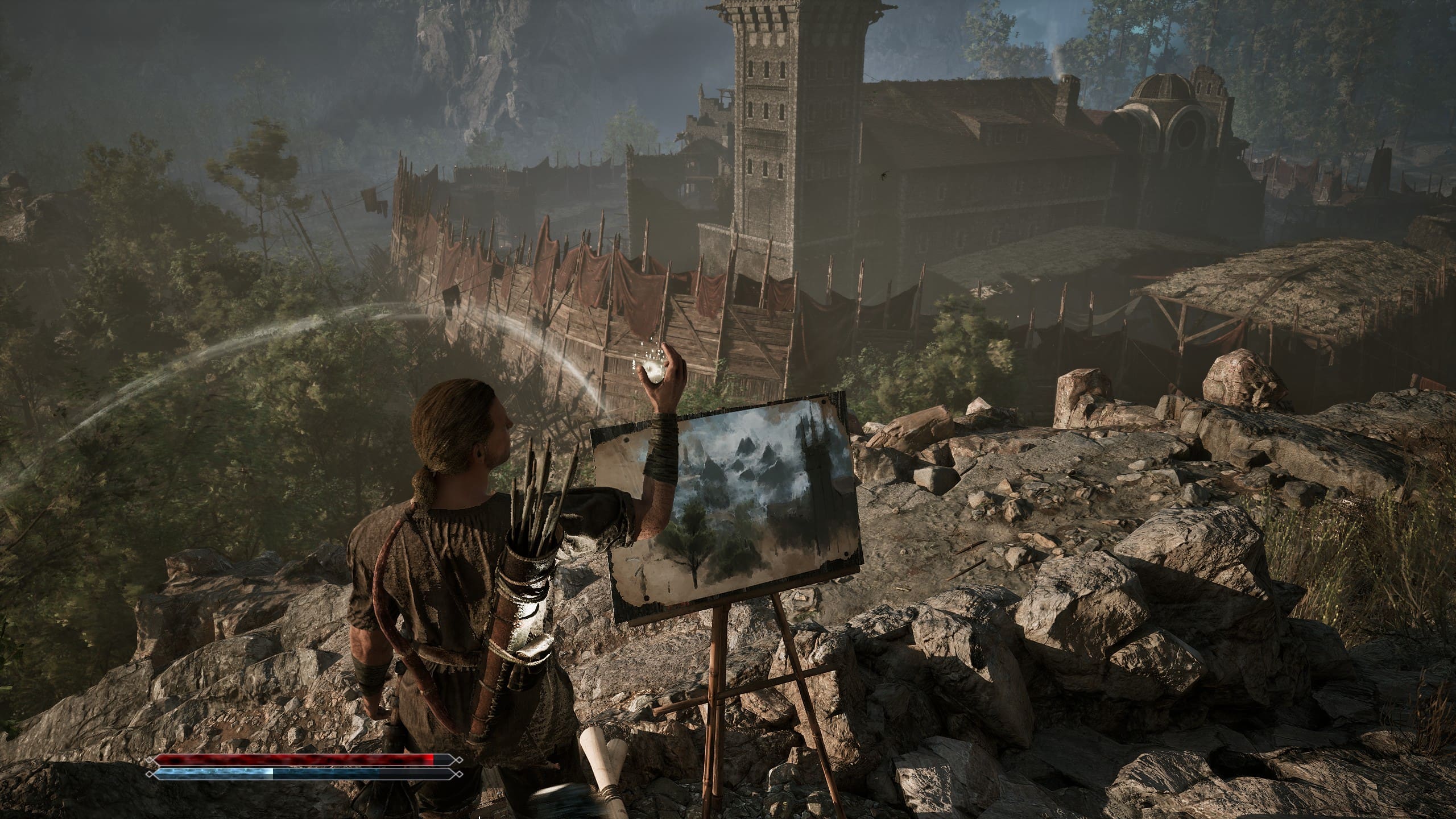
Gothic 1 has been technically and visually modernised using Unreal Engine 5, representing a significant leap in visuals, though it may not be the most aesthetically pleasing game. Nonetheless, it is an improvement over the original. The NPCs and wildlife have unique characteristics that enhance the game’s beauty. The environments vary greatly, ranging from warm forests to grey-washed mountains to the glowing underworld of the mines. Overall, the world surpasses the original by a wide margin, with many hard-to-reach areas offering stunning views of the landscape.
Combat in the game can be challenging to master. There are many teachers throughout the game who can assist you, but I recommend choosing a specific path to follow early on, as there is no option to redistribute skills or points later. I opted for a strength-based build because it significantly boosted my damage output in the early stages. Additionally, I focused on a single-handed melee build, investing in dexterity to improve dodging and speed. I also made sure to learn at least two levels in the lockpicking skill, as it is one of the most difficult aspects of the game. Other roles are available, such as mages and two-handed weapon specialists, but it was up to me to figure out what worked best for my playstyle. Based on my gameplay experience, I believe I developed a solid build that suited my approach to the game.
As with most games, I try to play them on the Steam Deck because I love the portability it offers. This game runs on the Steam Deck, but I had to make some configuration adjustments to ensure it runs smoothly. By utilising the FSR settings and upscaling, I was able to achieve a decent 30 frames per second. While the visuals weren’t stunning, the game was functional. However, I encountered some challenges during combat and primarily used the Deck for exploration and story elements. The game works perfectly with a gamepad, which is how I played it. I briefly tried using a mouse and keyboard, but didn’t enjoy the experience. For this title, I’ve been using the Steam Controller; however, most controllers will work.

Overall, Gothic 1 Remake is a compelling embodiment of early RPGs, characterised by its stark, brutalist elements that demand players’ full attention. Engaging deeply with the narrative and characters is essential; if I found myself distracted by my phone or skimming through dialogue, I quickly encountered challenges that made the experience far more difficult. Visually, the game captivates with its unique aesthetic, though it does exhibit a few rough edges.
Initially, I struggled with some design choices that felt frustrating, but as I continued my journey through the richly crafted world, I began to appreciate the intricacies of its gameplay. Rather than holding your hand, Gothic invites players to explore and learn through experience. This classic approach encourages a hands-on understanding of the mechanics, relying heavily on the save function to navigate its complexities. The game ultimately rewards those who are willing to persist, offering an immersive experience.
(Review code provided to Explosion Network.
Read about our review and ethics policy here.)